
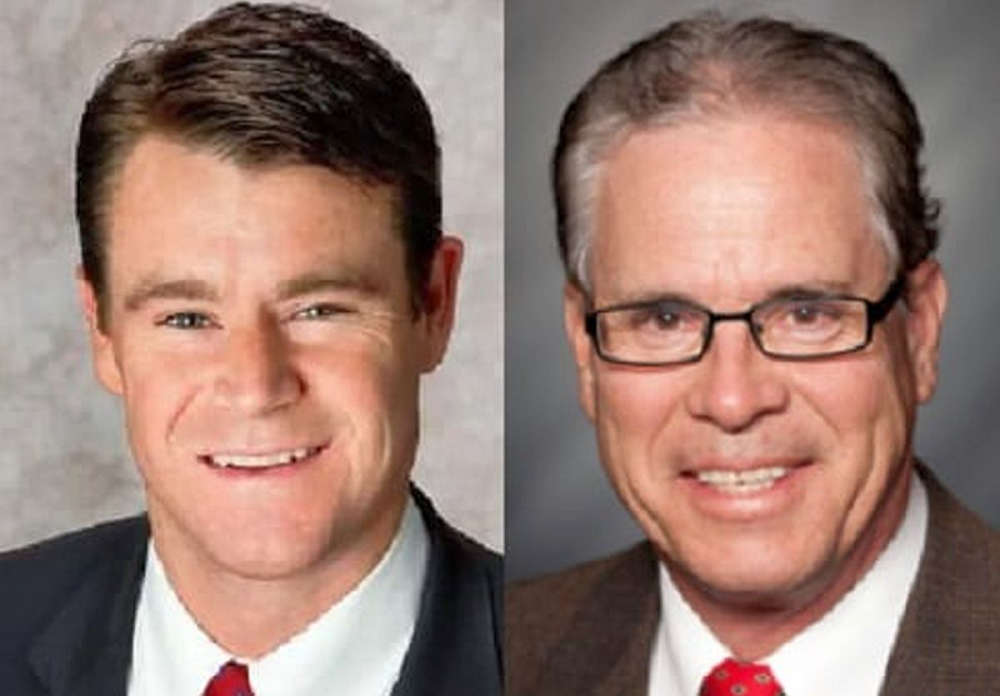
U.S. Senators Todd Young (R-Ind.) and Mike Braun (R-Ind.) recently introduced the HOUSE Act, legislation that would repeal a Biden Administration mandate related to energy standards that would significantly increase the cost of certain new homes.
“Hoosiers of all income levels are experiencing difficulty finding affordable housing. Our bill will repeal a new mandate from the Biden Administration that will unnecessarily drive up housing costs even further,” said Senator Young.
“Buying a home is more expensive than ever for Americans. We shouldn’t be making them even more expensive with government mandates that could add as much as $31,000 to the price of a new home. My bill will repeal this new Biden administration mandate so we can lower the cost of housing for American families,” said Senator Braun.
The HOUSE Act would:
- Repeal the Department of Housing and Urban Development (HUD) and the U.S. Department of Agriculture (USDA) Final Determination;
- Require HUD and USDA to revert to the 2009 standards already in effect;
- Prohibit the Department of Veterans Affairs (VA) from implementing a similar mandate for VA mortgages;
- Clarify that the Federal Housing Finance Agency has no statutory authority to impose similar mandates; and
- Reform the underlying law by prohibiting HUD and USDA from adopting new efficiency mandates unless at least 26 states have already adopted similar standards.
Earlier this year, the Department of Housing and Urban Development (HUD) and the U.S. Department of Agriculture (USDA) announced a Final Determination on energy efficiency standards for new construction of HUD- and USDA-Finance Housing. The new mandate requires that all new single-family housing construction financed through the agencies meet the 2021 International Energy Conservation Code standards.
According to the National Association of Homebuilders, these new minimum standards can add as much as $31,000 to the price of a new home, and it will take 90 years for homeowners to realize the energy savings from these regulations. Estimates indicate that for every $1,000 increase in the price of a home, 140,000 Americans are priced out of the housing market.
In addition to Senators Young and Braun, Senators Marsha Blackburn (R-Tenn.), John Barrasso (R-Wyo.), Cynthia Lummis (R-Wyo.), Shelley Moore Capito (R-W. Va), Roger Marshall (R-Kan.), Pete Ricketts (R-Neb.), and Eric Schmitt (R-Mo.) also cosponsored the legislation.
Full text of the HOUSE Act can be found here.
For years, Young has worked on housing affordability issues in Congress. In 2023, Young introduced three bills to address the national shortage of affordable housing:
- The Neighborhood Homes Investment Act, which would revitalize distressed neighborhoods by creating a tax credit for building and renovating homes in blighted areas.
- The Yes In My Backyard Act (YIMBY Act), which would eliminate barriers to much-needed housing by requiring transparency in local land use, zoning, and housing decisions.
- The Affordable Housing Credit Improvement Act (AHCIA), which would improve and expand the Low-Income Housing Tax Credit, providing an additional 44,500 units in Indiana alone.
 Vincennes man arrested in connection with fatal fire
 Red Hill Unit #10 adopts fiscal year budget;sets high school graduation
 Lawrenceville to seek state sidewalk improvement grant
 Early voting for November election underway in Illinois
 Postal Service recommends 2026 holiday mailing and shipping dates
 Lawrence County high schools recognized for student financial aid services
 Mock emergency drill planned in Lawrence County
 Unit #20 fiscally sound after passage of 2026-27 budget
 Illinois to close eight state visitor information centers
 Niemerg issues statement on no cash bail anniversary
 Lawrence County drivers reminded of Child Passenger Safety Week
 Fire injures one person in Vincennes
 Farm harvest safety reminders for drivers
 Southwestern Indiana fugitive arrested in Illinois after multi-county chase
 Governor Braun proclaims Indiana Rail Safety Week September 21-27
 Lawrence County (ILL.) man charged with child sex crime