

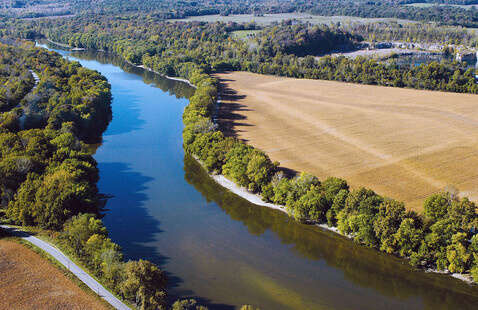
The Indiana State Department of Agriculture (ISDA) recently released an update to the State Nutrient Reduction Strategy (SNRS), a statewide strategy designed to improve water quality in Indiana, the Great Lakes and the Gulf of America.
The updated strategy represents the state's commitment to reduce sediment and nutrient runoff into Indiana's waters from point source and non-point source pollutants. It captures statewide efforts in Indiana that positively impact our waters as well as documents the progress of conservation, water quality improvements, and adoption of soil health and edge-of-field practices across the state.
Additionally, the strategy serves as a renewed effort to encourage outreach and education to conservation partnerships and the public regarding stewardship of Indiana’s waters.
“This updated strategy underscores the important work being done in land stewardship,” said Don Lamb, director of the Indiana State Department of Agriculture. “There have been many achievements since the start of the strategy, and by updating it will only strengthen our ability to achieve the goal of reducing excess nutrients in our waterways.”
The updated strategy was produced under the leadership of ISDA and the the Indiana Department of Environmental Management (IDEM) with the guidance provided by the Indiana Conservation Partnership (ICP) and the SNRS workgroup.
“Indiana has put a premium on data to ensure we have a complete assessment of water health throughout the state,” said IDEM Commissioner Clint Woods. “This guided plan gives us a strategic roadmap to better identify trends, address challenges, and measure progress over time, including impactful approaches to address harmful algal blooms and hypoxia.”
The following list includes objectives of this strategy:
- Raise awareness about the proper types of conservation practices to use on agricultural ground as well as other rural best management practices;
- Acknowledgment of the challenges facing the improvement of Indiana’s impaired waters;
- Involvement and engaging of stakeholders in the state’s efforts to reduce nutrient loads;
- Prioritization of HUC 8 watersheds within Indiana;
- Discussion of water quality monitoring and regulatory control of point sources;
- The inventory and utilization of resources to achieve their highest impact on nutrient reduction;
- Encouragement of voluntary incentive-based conservation through the many state and federal water quality related programs; and
- Illustrate the means by which the state will provide reports and accountability of assisted conservation practices reported by staff in the Indiana Conservation Partnership.
Click here for more information and to view the full strategy. Comments can be sent to ISDANutrientReduction@isda.in.gov.
 Callans seeks seat on Rockville Town Board
 Burkett eyes Vermillion County Council District 3 Seat
 IDHS warns against disaster assistance fraud
 Parke among the ten Indiana counties with reported measles cases
 Zamani seeks Vermillion County District 4 seat
 USDA announces record payments of $13.8 billion for 2025 crop year revenue and price safety net programs
 Nucor Corporation chooses additional expansion in Crawfordsville
 Applications open for Indiana's Advanced Nuclear Ready Communities Program
 USPS schedule for weekend into Columbus Day
 Equipment investments keep working for Indiana habitat
 Smith looks to punch ticket to Rockville Town Board seat
 Pair of motorcycle crashes keep Parke County Sheriff's deputies busy
 Parke Heritage Middle School awarded multi-million dollar Next Generation School Improvement Grant from IDOE
 BMV urges Hoosiers to complete voter registration by October 5 deadline
 Last day to ask your question for Indiana's next Secretary Of State