

Purdue Extension can help individuals in a lot of different ways including diagnosing a plant problem, identifying an insect, or assisting with various farm management tasks.
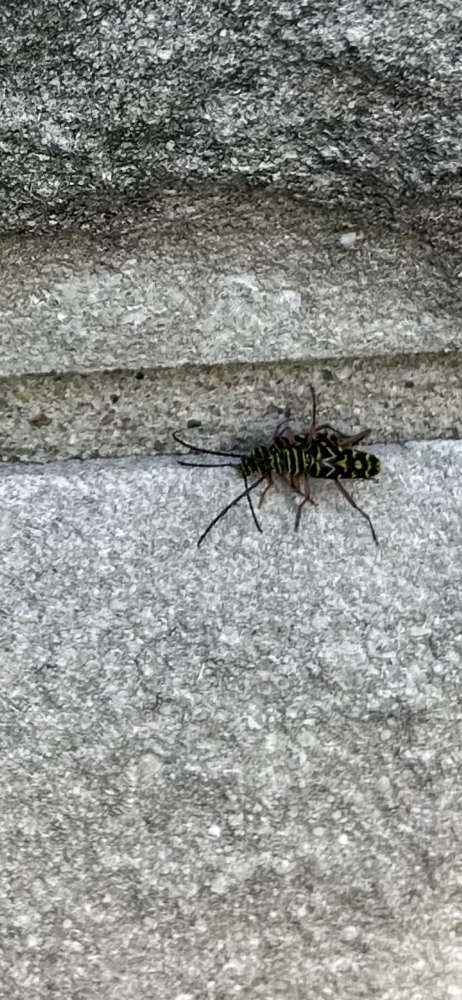
Recently we helped identify a unique insect found by an individual. This unique insect is the painted hickory borer (Megacyllene caryae).
The painted hickory borer is a large and conspicuous longhorned beetle, that is active from April through June. What makes it unique and eye catching is its striking markings and unusual resemblance to a wasp.
Measuring about 2 to 3 centimeters in length, the painted hickory borer features a jet-black body wrapped in bright yellow bands. A distinctive white, “W”-shaped marking stretches across its wing covers, making it easy to identify. Its reddish legs and black antennae add to its vivid appearance. Often seen in sunny areas, these beetles are frequently mistaken for wasps due to their coloration. This coloration is a clever form of mimicry that helps protect them from predators.
While their appearance may be startling, painted hickory borers play an important ecological role. They are beneficial decomposers that help break down fallen hickory trees and other hardwood species. By recycling dead wood, they contribute to nutrient cycling and overall forest health.
Despite these benefits, the beetles can sometimes pose challenges, particularly for those handling firewood or timber. Painted hickory borers lay their eggs in dead and decaying wood, where the larvae begin feeding just beneath the bark before tunneling deeper into the sapwood and heartwood as they develop. This activity can leave scars in the wood, which may reduce its value for lumber production.
However, these beetles rarely threaten living trees and typically do not require management in natural settings. Their presence is mostly a concern when they infest stored logs or firewood. Once the larvae are inside the wood, control options are limited.
Prevention remains the most reliable method of control. Landowners are encouraged to avoid leaving cut logs sitting for extended periods and to process wood promptly.
Overall, the painted hickory borer is more friend than foe. While it may occasionally cause minor issues, it remains a harmless and ecologically valuable insect. If you would like to know more about the painted hickory borer, please view the Purdue Extension Department of Entomology Hot News publication HN-48-W (https://extension.entm.purdue.edu/publications/HN-48.pdf) for more details.
Visit our homepage at www.extension.purdue.edu/putnam or you can contact the local Purdue Extension Office by calling 765.653.8411 for more information regarding this week’s column topic or to RSVP for upcoming events. It is always best to call first to assure items are ready when you arrive and to RSVP for programs. While many publications are free, some do have a fee. Purdue University is an equal access/equal opportunity institution. All times listed are Eastern Time.
Upcoming events:
May 25 – Extension Office closed for Memorial Day
May 27 – Cake Decorating Workshop, 4:30-6 pm, Fairgrounds
May 27-30 – 4-H Camp, call the office to see about further availability for campers
June 2- Phenology in Indiana presentation, 7-8 pm, Fairgrounds