
5-12-25 MONDAY NEWS 6 P.M.
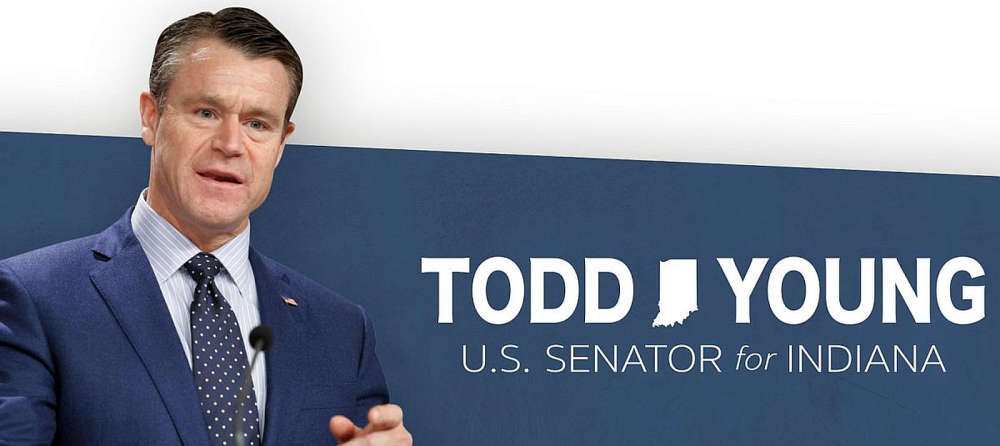
U.S. Senators Todd Young (R-Ind.) and Mark Warner (D-Va.) reintroduced legislation to revitalize housing in distressed neighborhoods in Indiana, Virginia, and nationwide.
Currently, private development lacks in some urban and rural areas because the cost of purchasing and renovating homes is greater than the value of the sale price of homes. The Neighborhood Homes Investment Act (NHIA) creates a federal tax credit that covers the cost between building or renovating a home in these areas and the price at which they can be sold. The legislation would cap the price of sales for each home to ensure that there are affordable housing options in these communities. The NHIA would also help existing homeowners in these neighborhoods to renovate and stay in their homes.
Under the NHIA, investors bear the risk as credits would be received only after rehabilitation is completed and the property is occupied by an eligible homeowner. To further ensure its effectiveness, the Treasury Department would be required to provide an annual report on the performance of the program.
“Across Indiana, we have seen once-vibrant neighborhoods struggle under poor economic conditions and lack of investment. The Neighborhood Homes Investment Act would help restore these communities by directing private capital into neighborhoods in low-income census tracts, bridging the gap between the cost of renovation and neighborhood property values,” said Senator Young. “This legislation also includes important guardrails to ensure that tax incentives target the families that need it most, continuing the work to avoid the negative and lasting consequences that a lack of safe, affordable housing has on Hoosier families.”
“I’m proud to partner with Senator Young on this bipartisan effort to address the lack of attainable housing in our communities. The Neighborhood Homes Investment Act will create new incentives for building and restoring affordable housing in areas that need it the most,” said Senator Warner.
More specifically, the NHIA would require that homes constructed or revitalized under the program must be sold to homeowners making less than 140% of the area median income. This ensures that improved housing directly benefits members of the communities targeted by the new tax credit. In addition, these credits are only eligible for houses constructed or revitalized in census tracts that meet certain minimum metrics related to median gross income, poverty rates, and home sale prices.
The credits would only be available after the homes have been completed and sold to a homeowner. NHIA targets neighborhoods that have poverty rates that are 130% or greater than the metro or state rate; have incomes that are 80% or less than area median income; and have home values that are below the metro or state median value. The maximum credit amount is the lesser of the excess of development costs over the sales price, 40% of development costs, or 32% of the national median price for new homes.
The NHIA tax credits would be awarded to project sponsors—developers, lenders, or local governments—through a competitive statewide application process administered by each state’s housing finance agency. Sponsors would use the credits to raise investment capital for their projects, and the investors could claim the credits against their federal income tax when the homes are sold and occupied by eligible homebuyers. State agencies would have annual allocation of either $9 per capita or $12 million, whichever is higher.
It has been projected that if enacted, the NHIA would:
- Finance the construction or rehabilitation of about 503,500 homes over 10 years;
- Generate $102.7 billion in wages and salaries;
- Spur $32.2 billion in federal tax revenue and $13.4 billion in state and local government revenue; and
- Provide 1,096,600 jobs in construction or construction related fields.
U.S. Representatives Mike Kelly (R-PA-16) and John Larson (D-CT-1) introduced companion legislation in the House of Representatives earlier this year.
Senator Young introduced the Neighborhood Homes Investment Act in 2023 with then-Senator Ben Cardin (D-Ma.). The legislation builds on Young’s efforts to address housing affordability.
Full text of the legislation can be found here.
 Rheese Benjamin finishes 8th at wrestling state finals
 U.S. Rep. Yakym’s bipartisan BARCODE Efficiency Act Advances
 Applications available for Indiana Sheriffs' Association college scholarships
 Parke County RDC closes on the purchase of the former Rockville National Bank Building
 Deadline approaching for blind, disabled Hoosiers and seniors to receive property tax credits
 One Night, One Cause: Indiana FFA needs your support for their ‘Blue and Gold Gala’
 Gov. Braun secures National Drone Test Site Designation for Indiana
 ISP with Human Trafficking Awareness Initiative this week
 Rockville Town Board shuffles up leadership positions
 Political candidates can begin filing this week
 Historic sites bill passes out of committee
 More than one-third of Christmas tree home fires occur in January
 Temporary visitation restrictions enacted by Union Health due to uptick in respiratory virus cases
 Reps. Heaton, Yocum: Indiana House accepting student applicants for 2026 page program
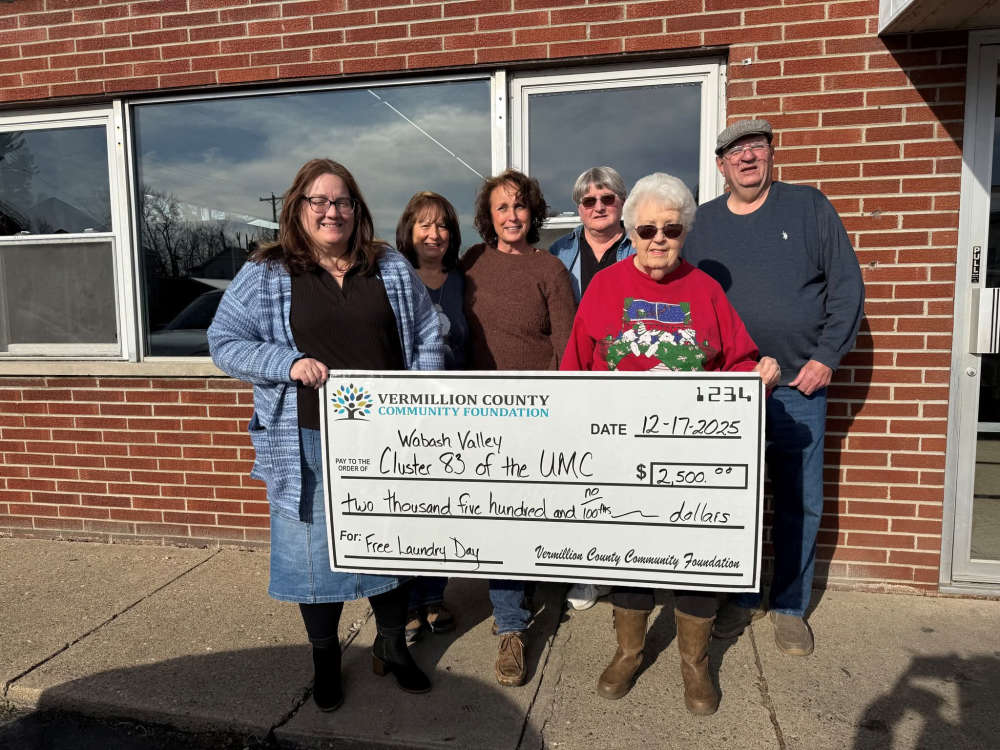 VCCF awards $2,500 grant to support Free Laundry Day Program