

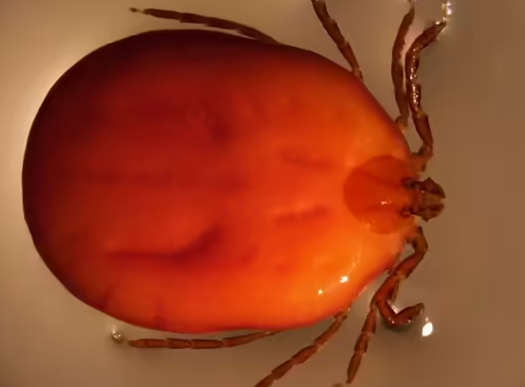
The invasive Asian longhorned tick (Haemaphysalis longicornis) was recently detected in a new county in Illinois, representing the third county in which it has been found following its first detection in 2024.
The detection was a result of a community-engaged program focused on tracking the range expansions and potential introductions of invasive tick species by soliciting ticks from the public, as well as working with livestock producers to collect ticks from farm animals.
Clay County cattle brought to the Marion County collection station were inspected for ticks. All collected ticks were initially identified at the INHS Medical Entomology Lab. Suspected H. longicornis ticks were sent to the USDA National Veterinary Services Laboratory for confirmation. Ticks collected from Clay County cattle included adult female H. longicornis. Sale and subsequent movement of cattle from farm to farm, whether between counties or states, is common. These detections highlight the role of such movement in the potential spread of this invasive tick species, as well as the importance of surveillance through community-engaged efforts in a shared One Health approach.
“The discovery of the invasive tick in another county shows that the pest is on the move across the state,” says Teresa Steckler, commercial agriculture specialist with University of Illinois Extension. "It’s important for everyone to do what they can to continually increase protection from tick bites in their own spaces, whether it be when spending time outside or caring for livestock.”
Asian longhorned ticks are of particular concern for livestock producers. It is parthenogenetic, or able to reproduce asexually, which facilitates introductions to new environments and allows for rapid increases in local population sizes. Its biting on infested livestock can lead to reduced growth and cause significant blood loss. It is capable of transmitting Theileria orientalis, a tick-borne protozoan. Native genotypes of T. orientalis in the United States are usually nonpathogenic; however, the virulent T. orientalis Ikeda genotype infects red blood cells and causes bovine infectious anemia. Clinical signs of theileriosis are similar to anaplasmosis in cattle and include anemia, jaundice, and weakness. The Ikeda genotype has been detected in 19 states, including Iowa, Missouri, Indiana, and Kentucky.
If you find a tick attached to an animal or a person, remove it immediately, using tweezers to grasp the tick as close to the skin as possible and pull gently. Wash the affected area with soap and water.
 St Francisville dealing with multiple issues
 Lawrence County seeking I.D.C. Director
 Tate to drop withdraw of guilty pleas
 Wind Advisory issued for region
 Authorities arrest two in Lawrence County
 Sumner to get grant for water system expansion
 Knox County man sentenced to prison
 Flooding impacting an area local utility, flood-prone homes to be disconnected
 Embarras River Flood Warning extended
 EIU Super-Sectional game audio: Lawrenceville 48, LeRoy 26 (original air date March 9, 2026)
 Lawrence County authorities make three weekend arrests
 IDHS focuses on raising awareness during Severe Weather Preparedness Week, March 8-14
 Edward Charles Ballinger, 65, Vincennes
 Rose named to Illinois Senate leadership team
 Indiana earns top credit rating from major agency