

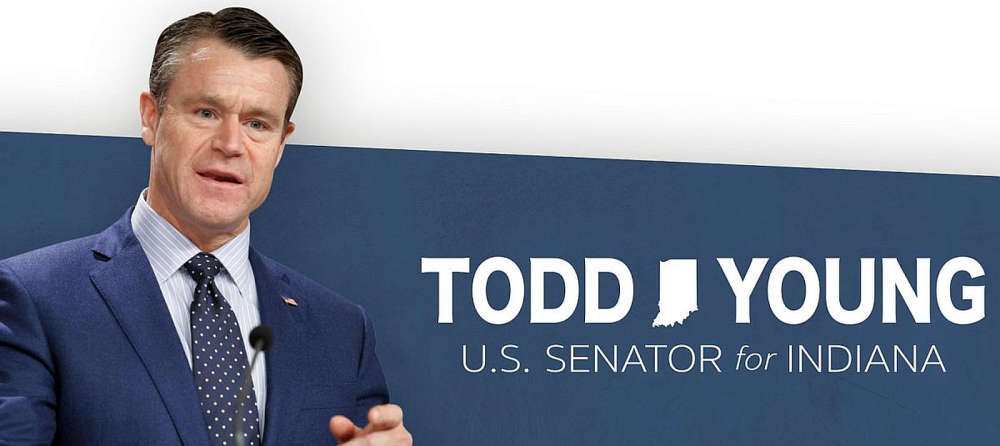
Today, U.S. Senator Todd Young (R-Ind.) voted for the final National Defense Authorization Act (NDAA) for Fiscal Year 2026. The legislation passed the Senate 77-20 and will now be sent to the President’s desk to be signed into law.
The annual defense bill sets policy for the Department of Defense (DoD), establishes national security priorities, and gives service members a much-deserved pay raise.
“The National Defense Authorization Act is one of the most important pieces of legislation Congress considers each year. I’m pleased this year’s bill includes several priorities I’ve worked on to modernize our defense capabilities, support Indiana’s defense industrial base and workforce, and maintain American leadership in biotech. This year’s NDAA also includes my bill to repeal the Gulf and Iraq War AUMFs and close the book on these ‘forever wars.’ I’ve been pushing for years to repeal these outdated AUMFs, and I am pleased that my repeal bill is included in the final NDAA. I look forward to President Trump signing this critical bill into law,” said Senator Young.
Senator Young worked to secure the following provisions in this year’s NDAA:
Support for Indiana’s defense capabilities and technologies:
- $10 million for reusable hypersonic test bed integration and testing for MACH-TB at Naval Surface Warfare Center-Crane Division (NSWC Crane) in southern Indiana.
- $10 million for PELE microreactor production by BWXT, which has a facility in Mount Vernon, and supported by Rolls Royce in Indianapolis. This cutting-edge technology will provide American military bases and installations with resilient, reliable electricity.
- $5 million for AI Maritime Maneuver (2.0) funding to support Trine University and NSWC Crane’s collaborative development of AI-enabled maritime maneuvering and navigation.
- Anti-Submarine Warfare Equipment funding to protect our Navy as they are on the forefront of securing vital sea lanes, securing commerce, and reducing threats to the homeland from the navies of China and Russia. Sonobuoys, like those manufactured by Ultra Maritime in Columbia City, are a vital tool in detecting and tracking submarine threats from our peer competitors.
- $5 million to support the Defense Innovation Unit OnRamp Hub, led by the Indiana-based Applied Research Institute (ARI), that will accelerate national security innovation and deliver emerging technologies to the DoD. Senator Young supported ARI’s winning application for this Hub project earlier this year.
- Authorizations for the procurement of additional Joint Light Tactical Vehicles (JLTVs), which will be built by AM General in Mishawaka.
- $12 million for the Quantum Communications Corridor to boost Indiana’s quantum footprint.
Critical updates to Indiana’s defense infrastructure:
- $72 million for Crane Army Ammunition Activity to modernize the production of pyrotechnics.
- $55 million to the Indiana Army National Guard in Shelbyville for critical flight facility upgrades.
- $18 million for an F-16 training facility in Fort Wayne.
The AUMF repeal bill, authored by Senators Young and Tim Kaine (D-Va.), to repeal the 1991 and 2002 Authorizations for Use of Military Force (AUMF) against Iraq. The Gulf War started 34 years ago, and the Iraq War began 22 years ago. These conflicts have long ended, and today Iraq is a partner, not an adversary. This legislation, which was included in both the House-version and the Senate-version of the NDAA, repeals the outdated AUMFs and close the book on these forever wars.
The BIOSECURE Act, legislation to prohibit federal contracting with certain biotechnology providers connected to foreign adversaries. This effort stems in part from Senator Young’s role as chair of the National Security Commission on Emerging Biotechnology (NSCEB). The NDAA also includes 17 other NSCEB recommendations that would spur biotech innovation critical to our national security and defense capabilities and ensure the U.S. maintains global leadership in biotechnology.
Provisions included in the Intelligence Authorization Act (IAA) to authorize funding, provide legal authorities, and enhance oversight of the U.S. Intelligence Community. The NDAA includes language that would help keep America secure by addressing threats to our defense, industrial, agricultural, and health sectors. Three pieces of legislation authored by Senator Young were included in the IAA and the NDAA:
- The Advanced AI Security Readiness Act, which directs the National Security Agency to develop an AI security playbook to protect America’s advanced technology from foreign adversaries;
- The Enhanced COVID—19 Transparency Act, which directs a thorough declassification of intelligence to advance the American people’s understanding of China’s malign activities during the COVID—19 pandemic; and
- Legislation to require a strategy by the Director of National Intelligence to enhance the sharing of intelligence with federal departments and agencies on the frontlines of economic and technological competition.
 Special Olympics Indiana hosting 54th annual state basketball tournament
 Indiana State Police Internet Crimes Against Children (ICAC) Task Force reporting progress
 Thrive info session planned for March 26
 BMV warns of scam, more deceptive messages
 Howell looks back fondly on time with Cloverdale Town Board
 Tancak reflects on tenure with Cloverdale Town Board
 Brandon Tancak, Brice Howell resign from Cloverdale Town Board
 Indiana Department of Veterans Affairs, American Legion Department of Indiana sign landmark agreement