

Today, U.S Senators Todd Young (R-Ind.), Jeanne Shaheen (D-N.H.), Mike Rounds (R-S.D.), and Catherine Cortez Masto (D-Nev.) introduced legislation to support domestic supply chains for critical minerals to meet national and economic security needs through the creation of a new Strategic Resilience Reserve (SRR).
Critical minerals have emerged as a key chokepoint in the global economy and give adversaries like China and Russia enormous leverage, as they’ve demonstrated in the past. Just like the Strategic Petroleum Reserve and the CHIPS and Science Act have created more resilient domestic supplies of energy and semiconductors, this legislation will play a vital role in insulating the U.S. economy from external threats and creating good-paying jobs at home.
Specifically, the Securing Essential and Critical U.S. Resources and Elements (SECURE) Minerals Act would establish the SRR in an independent government corporation—run by a seven-member board appointed by the President and confirmed by the Senate—to focus on supporting the critical minerals market, including through stable prices, and expanding domestic and allied production capacity, stockpiles, competitive markets, and supply chains, with minerals where the U.S. is reliant on China (including rare earths, where China controls 90 percent of processing). The legislation also prioritizes support for projects that recycle, reuse, or repurpose critical minerals or extract minerals from mining or industrial waste.
For years, China has leveraged its dominance of critical minerals by manipulating global markets and supply chains. Our bill would counter China’s ongoing coercion and ensure the United States has a secure and accessible supply of the minerals that power our defense systems and high-tech industries. Creating this Reserve is a much-needed, aggressive step to protect our national and economic security,” said Senator Young.
“China’s global dominance of critical minerals supply chains gives it significant leverage and leaves the U.S. vulnerable to economic coercion. This bipartisan legislation is a historic investment in making the U.S. economy more resilient and supporting good-paying jobs in key sectors like aerospace, autos and technology,” said Senator Shaheen. “Delivering much-needed stability to the market, providing targeted investments and stockpiling key inputs will help insulate the U.S. from foreign threats and will provide a significant, and cost effective, boost to the U.S. economy.”
In the U.S. House of Representatives, Representatives Rob Whittman (R-VA-1) and John Moolenaar (R-MI-4) introduced companion legislation.
Full text of the legislation can be found here. A one-pager for the legislation can be found here.
 American Red Cross urges the public to donate blood
 Rheese Benjamin finishes 8th at wrestling state finals
 USDA launches Lender Lens Dashboard to promote data transparency
 Cancer Action Day at the Indiana Statehouse: Advocates call for legislation to reduce the burden of cancer
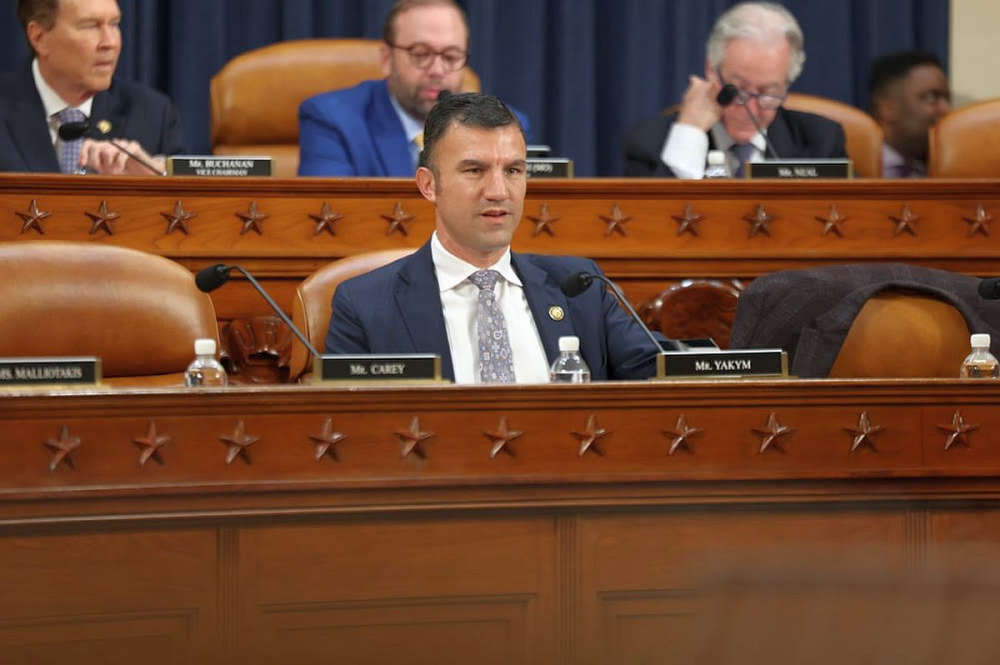 U.S. Rep. Yakym’s bipartisan BARCODE Efficiency Act Advances
 Applications available for Indiana Sheriffs' Association college scholarships
 Parke County RDC closes on the purchase of the former Rockville National Bank Building
 Deadline approaching for blind, disabled Hoosiers and seniors to receive property tax credits
 One Night, One Cause: Indiana FFA needs your support for their ‘Blue and Gold Gala’
 Gov. Braun secures National Drone Test Site Designation for Indiana
 ISP with Human Trafficking Awareness Initiative this week
 Rockville Town Board shuffles up leadership positions
 Political candidates can begin filing this week
 Historic sites bill passes out of committee
 More than one-third of Christmas tree home fires occur in January
 Temporary visitation restrictions enacted by Union Health due to uptick in respiratory virus cases