


health-department-warns-of-tick-season
Indiana health officials are urging Hoosiers to protect themselves from tick bites during and after spending time outdoors to protect themselves from tick-borne diseases.
“Even though we’ve had a cool, wet spring, ticks are already out and looking for their next meal,” said State Public Health Veterinarian Jen Brown, D.V.M., M.P.H. “The risk for tick-borne disease is at its highest for the next few months, so we want Hoosiers to protect themselves by taking precautions against tick bites.”
While Lyme disease is the most common tick-borne disease in Indiana, Hoosiers are also at risk for other tick-borne diseases, including ehrlichiosis and spotted fever group rickettsiosis (a group of diseases that includes Rocky Mountain Spotted Fever). While the risk for Lyme disease is highest in northwest Indiana and the risk for ehrlichiosis is highest in southern Indiana, ticks that carry these diseases have been found throughout the state. All Hoosiers should take precautions to prevent tick bites from early spring through late fall, when ticks are most active.
Preventing tick bites is the best way to prevent tick-borne diseases. Hoosiers can take the following precautions to prevent tick bites:
Know where ticks are likely to be present (close to the ground in grassy, brushy or wooded areas); Treat boots, clothing and outdoor gear with 0.5% permethrin (NOTE: permethrin should NOT be used on bare skin); Use EPA-registered insect repellents with active ingredients such as DEET, picaridin, IR3535, oil of lemon eucalyptus (OLE), para-menthane-diol (PMD) or 2-undecanone; Treat your pets for ticks in consultation with a veterinarian.Once indoors, people should thoroughly check for ticks on clothing, gear, pets and skin. Tumbling clothes in the dryer on high heat for 30 minutes will kill ticks, and showering can help remove any unattached ticks.
“Tick checks are an essential part of preventing tick-borne diseases. Promptly removing an attached tick can prevent you from becoming sick in some cases,” Brown said.
Ticks may be safely removed by using tweezers to grasp the tick close to the skin and then pulling outward with steady and even pressure. After the tick is removed, the area should be washed thoroughly. Ticks should never be crushed with the fingernails.
If desired, an attached tick that has been removed may be saved in a sealed bag or container of alcohol for later inspection in case the person or pet becomes ill. Alternatively, ticks may be flushed down the toilet or wrapped tightly in tape and thrown in the trash. Testing ticks to see if they are carrying diseases is not generally recommended, as the information cannot reliably be used to predict whether disease transmission occurred.
Anyone who becomes ill after finding an attached tick should see a healthcare provider immediately and alert the provider to the exposure. Most tick-borne diseases can be treated with antibiotics, and prompt diagnosis can help prevent complications.
For more information about ticks and how to prevent the diseases they carry, see the IDOH website at http://www.in.gov/isdh/20491.htm.
 May primary ballots set for Vermillion County
 SW Parke identifies 'Big Five' themes for Revision Project
 Lucas Oil named title partner of 500 Festival Parade
 Applications open for new United Way of Central Indiana initiative to build community solutions
 Utilities District of Western Indiana REMC announces increases over next three years
 Fountain County man arrested on sex crime charges, Parke County investigation remains
 Friday is National Wear Red Day
 Vermillion County DCS worker facing felonies
 One week left to file for office in Indiana
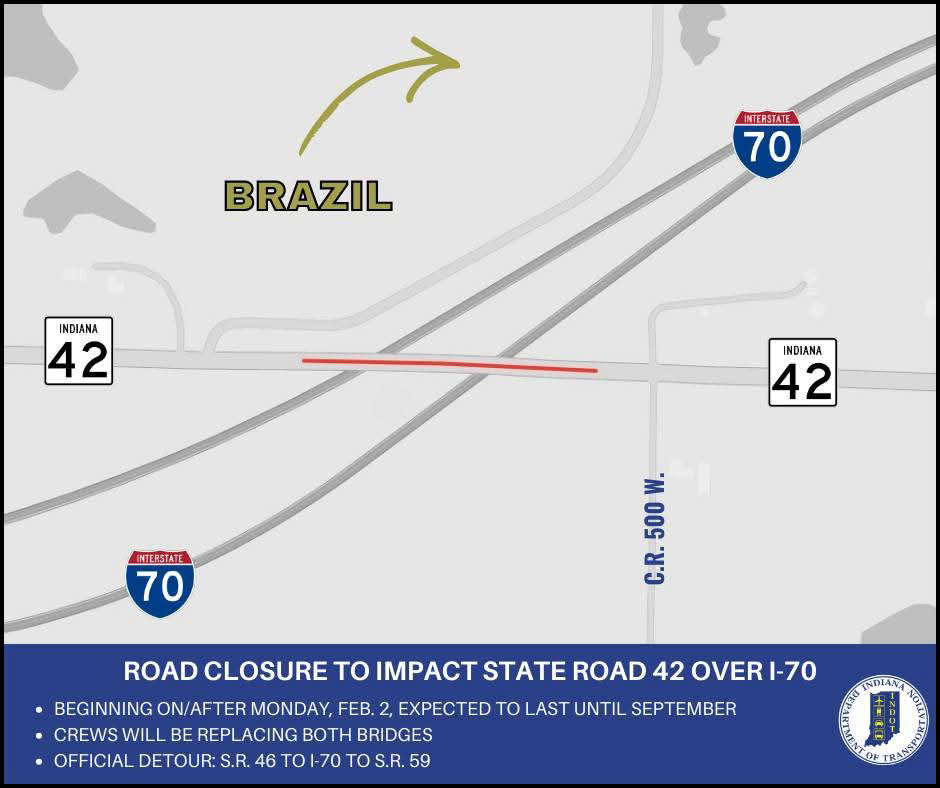 Bridge closures to impact State Road 42 over I-70 in Clay County
 Road renaming resolution co-authored by Criswell to honor Bobby Knight passes House
 Thrive West Central to host Utility Workshop
 Greene Realty continues to grow
 World Food Championships set for 2026 Indianapolis return
 NWS extends Winter Storm Warning to Monday morning
 IDHS activates State Emergency Operations Center in response to winter storm